

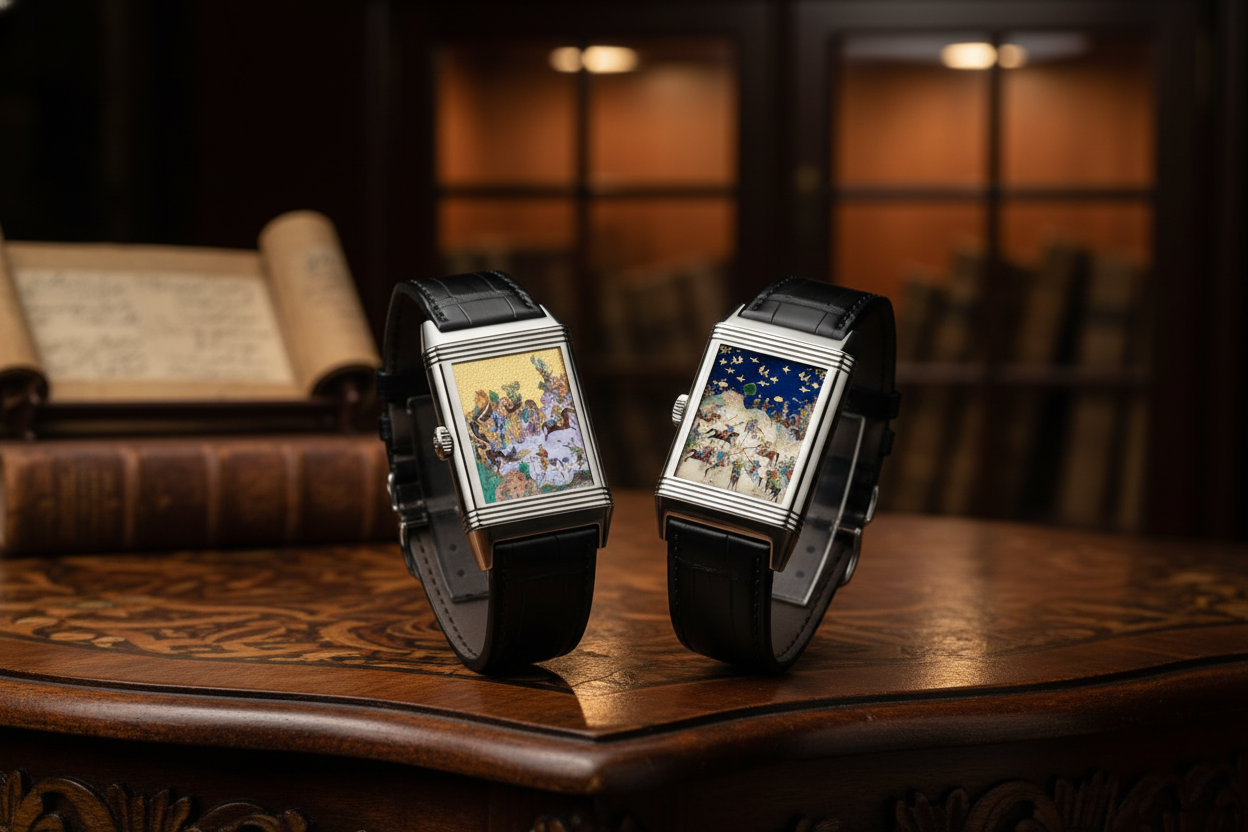
"Shahnameh" Tribute Enamel by Jaeger-LeCoultre Reverso
A thousand years of Persian art, revived on the wrist.
One of the oldest epic poems in the world is turned into wearable art with the Jaeger-LeCoultre Reverso Tribute Enamel "Shahnameh," a poetic fusion of horology and tradition. The Reverso has long served as a blank canvas for tiny enamel painting because of its flip cover and plain back. In this four-part series, Jaeger-LeCoultre (JLC) honors Ferdowsi's 11th-century Persian literary classic, the Shahnameh, also known as the "Book of Kings."
The pictures in the collection were commissioned in the 16th century by Shah Tahmasp, the second Safavid dynasty king. More than 250 paintings were previously included in that fabled text, which took 20 years to finish and is called The Shahnameh of Shah Tahmasp. Its vivid colors, intricate representations of myth, and celebration of royal virtue continue to make it one of the best specimens of Persian miniature painting, despite being dispersed throughout museums today.
The Canvas on the Reverso
The Reverso was first designed in 1931 for British officers in India who needed to shield their watch crystals during polo tournaments. Since then, it has undergone significant change. Today, its rotating case acts as a link between great art and horology. One of the few watchmakers with an enameling workshop on-site, Jaeger-LeCoultre, has honored artists from Monet to Van Gogh using this format. However, the "Shahnameh" editions represent a significant cultural change, shifting the focus from Europe to the Middle East, the birthplace of polo.
The four white-gold timepieces in this limited edition each have a unique enamel miniature that portrays well-known Persian mythological scenes on the back:
- Siyavush Plays Polo before Afrasiyab
- Faridun Tests His Sons
- Saam Comes to Mount Alburz
- Rustam Pursues Akvan
The Persian epic's moral drama and vivid storytelling are brought to life in these pieces, which were created by JLC's master enamellers utilizing ancient Grand Feu techniques. The dials, on the other hand, are tastefully simple and feature flinqué enamel, which is a coating of translucent enamel put over a guilloché basis.
Detail and Craftsmanship
Each Reverso "Shahnameh" is housed in the iconic Grande Taille white-gold case and measures 45.6 mm by 27.4 mm with a thin height of 9.73 mm. The Calibre 822, a hand-wound movement made especially for the rectangular shape of the Reverso, beats inside. With a 42-hour power reserve and a sophisticated design that accentuates the understated elegance of the front dial, the movement, which was first introduced in 1991, continues to set the standard for dependability and simplicity.
Although the front dials vary slightly, some have a lozenge design in forest tones, while others have wave guilloché in sea green, all of them stick to the simple, Art Deco proportions that characterize the Reverso line. These fronts provide understated elegance, guaranteeing that the enamel painting that is exposed when the case is turned over stays the primary attraction.
Tales in Enamel
The narrative depth of two of the four timepieces is particularly noteworthy. In "Saam Comes to Mount Alburz," the prince makes a comeback to retrieve Zal, his albino son, whom he had left behind due to superstition. Perched above the mountains in the scene is the legendary Simurgh, a knowledgeable and kind bird that reared Zal and represents atonement and divine direction. Its sweeping fluidity and jewel-like hue are captured in JLC's replica of the original folio, which is housed in Berlin's Museum of Islamic Art. The Persian hero is shown fighting a horned demon that can transform into a onager (wild donkey) in "Rustam Pursues Akvan," which is currently housed in the Aga Khan Museum collection. Rustam defeats the demon by tricking him with cunning and might, a classic example of intellect triumphing over force. From the twisted corpses to the elaborate Persian designs enclosing the scene, every brushstroke on the enamel surface evokes tension and action.
Art on the Wrist
Even while the dials are beautiful, they might not have the same transcendence as the small enameling on the reverses, which reaches almost museum level. Reviewers pointed out little variations in the flinqué enamel's clarity on the prototypes; they will probably be fixed in the finished product. Nevertheless, these timepieces rank among the best métiers d'art in contemporary horology due to their entire execution. The Reverso Tribute Enamel “Shahnameh” reaches rarefied status for over $142,000 USD per. The cost, however, is a reflection of both the historic value of preserving Persian art in Swiss craftsmanship as well as the hours of hand painting needed for each dial.
A Gathering of Civilizations
These timepieces are more than just rarities; they are a meeting of two traditions: Persian poetry and Swiss precision. The "Shahnameh" Reverso shows how the language of art is not limited by time or place. For collectors, it provides a material connection to a thousand years of storytelling, encapsulated in enamel, gold, and fire; for Jaeger-LeCoultre, it is a contemplative recognition of the worldwide legacy that informs contemporary luxury. The Reverso Tribute Enamel "Shahnameh" challenges us to stop, flip the page, rediscover history, and realize that time itself may be a work of art in a world that goes quickly.


Mechanical Wonders at the Louvre, From Ancient Egypt to Vacheron Constantin
Mécaniques d'art, which opened on September 17th to commemorate the 270th anniversary of Vacheron Constantin, the museum's philanthropic partner, is an exhibition at the Louvre dedicated to mechanical art objects, specifically ten historically significant clocks and watches (though some of the oldest are only fragments).
The exhibit, on display in the Sully wing until November 12th, shines a welcome light on an often-overlooked aspect of the museum's decorative arts collection; pieces that merge technical expertise with mankind's obsessive quest to measure time and explain the heavenly bodies.
La Québec du Temps, the magnificent astronomical clock that Vacheron Constantin displayed last month, is the focal point of the space.
If you can't make it, you should still have a look at the amazing items on exhibit, which are arranged chronologically.
A piece of an Egyptian Clepsydra, circa 332–30 BC
The oldest clock on display is about 2,300 years old, decades before mechanical clocks. Its state is explained by its antiquity; all that's left of an ancient Egyptian clepsydra, or water clock, is a small shard. The fundamental technology used in the construction of this water clock dates back hundreds of years. Experts estimate that this kind of clepsydra could measure time to within about 15 minutes per day, accurate enough for use in practical, ceremonial, or astronomical contexts. The device was essentially a flat-bottomed vessel with a hole drilled precisely so that water would leak out at a predictable rate.
The vessel's interior was marked with concentric circles to represent the hours and, in order to keep with the seasons, distinct marks for each of the year's twelve months.
A portion of an automated clock shaped like a peacock Cordoba, around 962 or 972
The exhibit's second-oldest clock is a fragment that is thought to have been a part of a crude mechanical clock constructed for the Caliph's court in Córdoba, Spain, in the tenth century. It is thought to have been a component of a mechanical peacock that would drop pellets from its mouth to indicate the hours because it resembles other known Hellenistic clocks of this kind. Similar to crown jewels, these objects were used in courtly settings to show the ruler's strength and divine authority. Its artistic shape serves as another reminder of how closely design and ornamentation have been linked to horology since its inception.
Spherical Timepiece
Blois, Jacques de la Garde, 1551
The third clock in the display is from the 16th century, when the first portable spring-driven clocks appeared. The spherical watch on exhibit was manufactured in Blois in 1551. making it the one of the oldest known French made watches bearing both a signature and a date.
It was a crude, one handed gadget that was undoubtedly incredibly inaccurate by today's standards, but it was the most advanced technology available at the time. Similar to how haute horlogerie wristwatches are used now, a watch like this would have served as a social status indicator.
Table Clock in the Shape of a Square Tower
Germany, late 16th century
For as long as there have been clocks and watches, the wealthy and influential have sought for or commissioned unique designs to indicate their social standing. Such a clock, modelled after a fortified tower and adorned with the coat of arms of the influential Farnese family of Parma, Italy, is the fourth item on exhibit.
The brass, bronze, and silver clock was most likely manufactured soon after Jacques de la Garde's spherical watch. To convey the owner's authority and sense of style, it is elaborately ornamented from top to bottom. An allegory of justice is etched on the back of the clock, most likely to support the Farnese family's superior status in society.
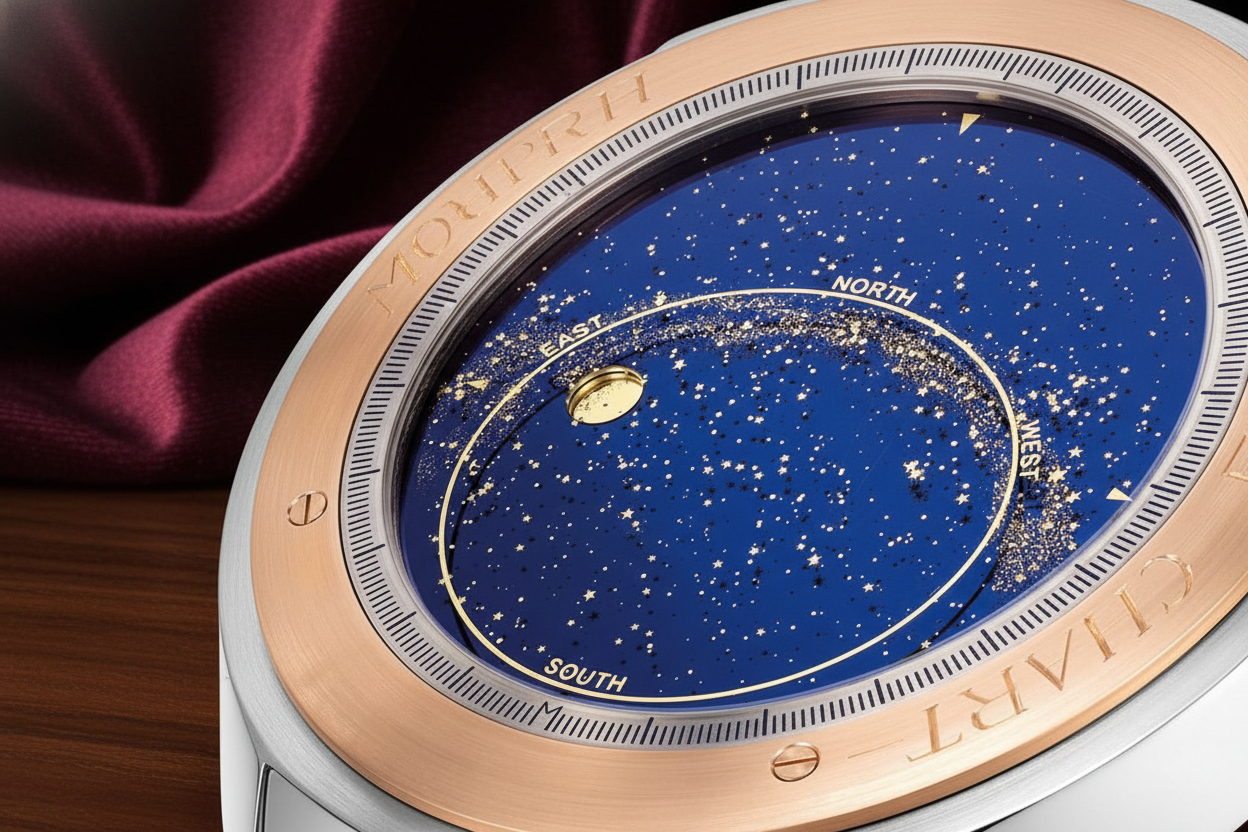
Patek Philippe Star Caliber 2000 Under the Hammer at Sotheby’s Abu Dhabi
The Patek Philippe Star Caliber 2000 stands as a true masterpiece of modern horology a pocket watch that redefined what mechanical ingenuity could achieve. Created to celebrate the dawn of a new millennium, it was once the fourth most complicated timepiece ever made. Yet, beyond its record-breaking complexity, its brilliance lies in the harmony of art, engineering, and imagination that reshaped the very concept of grand complications.
Now, an original complete set of four Star Caliber 2000 watches is set to make history once again. Sotheby’s will offer this exceptional collection at its first ever watch auction in Abu Dhabi this December the first full set ever to appear publicly. A moment destined to captivate the world’s most discerning collectors and horological institutions alike.
The Technical Significance of the Star Caliber 2000
The Patek Philippe Star Caliber 2000 may not have held the title of “the world’s most complicated watch,” but that was never really the point. What makes it extraordinary is how it redefined what mechanical mastery could look like at the turn of the millennium When it launched, the Star Caliber 2000 ranked fourth in the hierarchy of complications following Patek Philippe’s own Caliber 89, the legendary Henry Graves Supercomplication of 1932, and the lesser-known but equally impressive Leroy 01 from 1904. Yet, where others chased complication counts, the Star Caliber 2000 pursued coherence. Every mechanism served a purpose, every display felt deliberate a hallmark of Patek’s philosophy at its most poetic.
Two and a half decades later, it’s been surpassed on paper by newer feats from Vacheron Constantin and Audemars Piguet, but the Star Caliber 2000 remains a reference point a moment when Patek Philippe showed that complexity, when done right, could still feel effortless.
But the Star Caliber 2000 was never meant to be defined by rankings or numbers that kind of scoreboard is, at best, superficial. Its true genius lies in the substance of its innovation. Beneath the gold case lives a suite of groundbreaking mechanisms, protected by six patents four tied to complications and two to ingenious utility systems each representing a genuine leap forward in how watchmakers think about mechanical architecture.
More importantly, the Star Caliber 2000 stands as Patek Philippe’s last great super-complication pocket watch, the final expression of a tradition that stretches back to the Graves era. It remains not just a technical marvel, but a benchmark in modern watchmaking a reminder that true mastery isn’t measured by how many complications you can fit into a case, but by how seamlessly they all come together.
mong the Star Caliber 2000’s many marvels, its grand sonnerie stands out as the most poetic and the most sonorous. The chiming sequence follows the same musical pattern as Big Ben’s legendary bells in London’s Elizabeth Tower, ringing out with five gongs that fill the air with depth and resonance. When activated, the grand sonnerie performs a symphony of time: the quarters strike first, followed by the hours a deliberate inversion of convention. Even the minute repeater plays by its own rules, sounding in a distinct order of quarters, then minutes, then hours a subtle but elegant rethinking of a centuries-old tradition.
Then there’s the watch’s celestial centerpiece the star chart with orbital moonphase, a first of its kind when introduced. This astronomical display tracks the night sky with mesmerizing precision, mapping the stars as seen from Geneva. The concept would later inspire icons like the Sky Moon Tourbillon ref. 5002 and the Celestial ref. 5102, but it all began here with the Star Caliber 2000, where art and astronomy met inside a pocket watch.
A Masterwork Born of Collaboration
“Every great complication is a symphony and the Star Caliber 2000 had its orchestra.”
Like every true masterwork of haute horlogerie, the Star Caliber 2000 was the result of collective genius. Patek Philippe turned to the legendary Jean Pierre Hagmann to craft the cases, each one a study in balance and proportion. The finishing touch came from Christian Thibert, whose meticulous hand-engraving transformed metal into art.
At the bench, Jean-Pierre Musy led the team responsible for assembling and regulating each movement 1,118 components per watch, each polished, adjusted, and harmonized until the entire mechanism sang in perfect mechanical rhythm. It was an achievement that could only be realized through the fusion of experience, precision, and patience.
Details on the Present Lot
Patek Philippe produced just five complete four-watch sets of the Star Caliber 2000, for a total of 20 pieces. One set was crafted entirely in platinum, while the other four were presented in yellow gold, rose gold, white gold, and platinum. Production began with movement number 3’200’001 and concluded with 3’200’020, marking one of the most exclusive limited runs in modern horology.
The set appearing at Sotheby’s Abu Dhabi represents the fifth and final ensemble, comprising movement numbers 3’200’017 to 3’200’020. For collectors, it’s more than an auction lot it’s the closing chapter in Patek Philippe’s era of monumental pocket watch innovation.
How Three Centuries Of Innovation Turned Timekeeping Into An Art Form
You would be mistaken to believe that punctuality is a contemporary art form; it was essentially developed in the 18th century. In those days, timepieces were proudly displayed as symbols of elegance, yet they were only as accurate as a sandstorm weather forecast. These days, your smartwatch can monitor your stress levels, steps, and pulse. If theirs could make it through the day without losing three hours, people were ecstatic three hundred years ago.
At Horology Forum 10 during Dubai Watch Week, enthusiasts and historians recounted how centuries of experimentation, failure, and epiphanies transformed timekeeping into a science and art, and how the Arab world still has a fixation with it today.
When Watches Were Wobbly but Wonderful
Imagine living in the 1600s without Wi-Fi, matcha and certainly no atomic clocks. The first "portable" watches were essentially big, bulky, and always incorrect tiny church towers that you could wear with one hand. The first timekeeping device, the Verge escapement, required frequent rewinding and heavenly patience because to its inconsistency. However, as one watchmaker remarked, "It danced, but it danced badly."
It was a start, though. With the invention of the waistcoat and pockets, men could now take a small piece of mechanical chaos with them wherever they went. An technical marvel and a great way to strike up a conversation while you're two hours early for an appointment you're still going to miss.
The Great Leap Forward (Give or Take Ten Minutes)
Enter Robert Hooke and Christiaan Huygens, who around the 17th century decided that being wrong by a few hours wasn’t good enough. They introduced the balance spring, the beating heart of the modern watch, which cut inaccuracy to a mere ten minutes a day. Finally, people could set appointments they had a fighting chance of keeping. Then came the Cylinder escapement, because apparently, thin was in both in waistcoats and in watches. For the first time, elegance joined accuracy, and the wrist’s ancestor, the pocket watch, became a true fashion statement.
When the Watch Learned to Think
Thomas Mudge's invention of the lever escapement in the 18th century was a silent revolution that gave timepieces their beloved tick-tock heartbeat and enabled them to start themselves. Finally, a watch could function without a skilled tap. Even the best clocks became a bit cranky when it was too hot, so Pierre Leroy devised the brilliant notion to adjust for temperature variations. In order to maintain a stable time, his split bimetallic balance wheel employed two metals that expanded at opposite speeds. Consider it the first "climate control" system in horology.
Longitude and the Invention That Saved Sailors
Fast-forward to the era of empire, when being off by a few seconds could strand a ship hundreds of miles from safety. Enter John Harrison, a man who spent 36 years solving the Longitude problem and proving that watchmaking could literally save lives.
Part miracle, part legend, his H4 chronometer clock was accurate to within seconds of the day. It was deemed so important by the British government that it was designated as a state secret. Harrison's masterpiece at the time was the GPS of the Age of Sail; today, we gripe when our phone clock is three seconds off.
The 21st-Century Twist
Fast-forward again, this time to Dubai, where Seddiqi Holding hosts Dubai Watch Week, gathering the heirs of those early innovators. Instead of verge escapements, we now have tourbillons, perpetual calendars, and sapphire cases that cost more than most apartments. Yet the obsession is the same: precision, beauty, and bragging rights.
Where sailors once relied on chronometers to chart the seas, today’s collectors turn to their watches to chart style and taste. Where artisans once pursued perfect time, modern brands pursue perfect craftsmanship and storytelling. The spirit, however, remains unchanged, a shared devotion to beauty, precision, and the quiet pride of owning something extraordinary
Why History Still Ticks
The history of horology is dynamic rather than dusty. Every tick of a contemporary wristwatch is a hint from a time when creativity, experimentation, and trial were all part of the past. Previously navigating oceans, art today navigates identities, particularly in the Arab world where collecting has evolved into a statement of ancestry and intelligence rather than merely wealth. As the old watchmakers might say, perfection takes time. Fortunately, they gave us something beautiful to measure it with.
The Legacy of Time, How Arabs Collecters Perserve History Through Watches
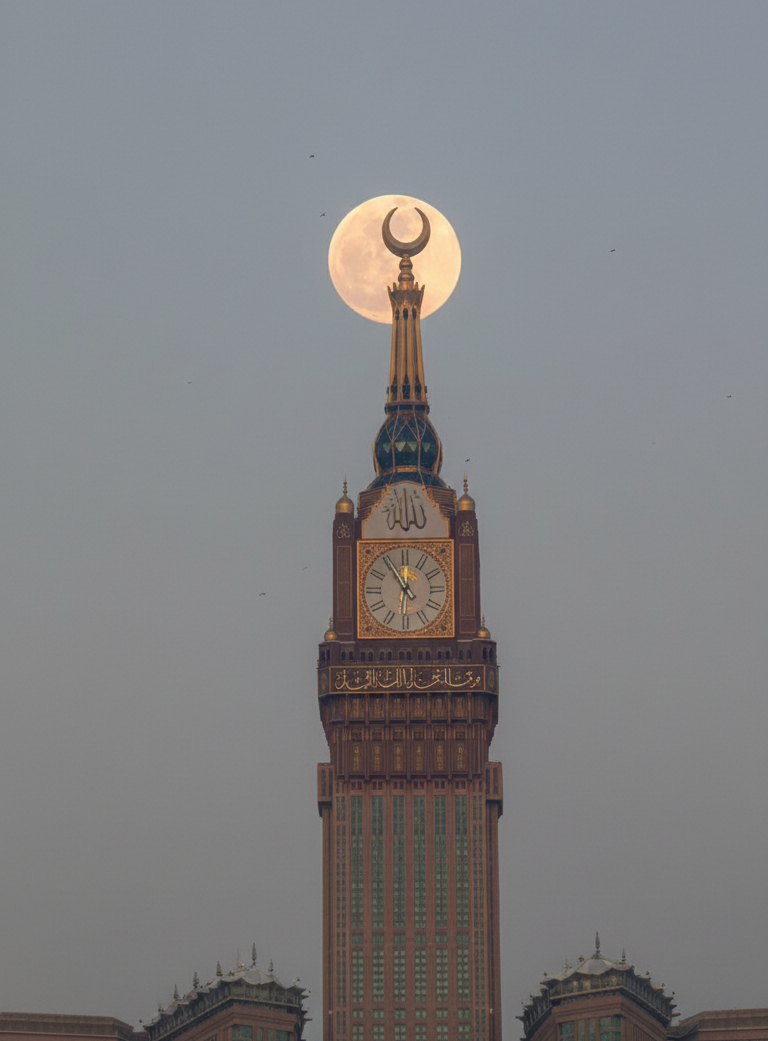
In the Arab world, time is not just measured it is felt, lived, and remembered. For centuries, our culture has valued craftsmanship, beauty, and meaning in every creation. From the calligrapher’s steady hand to the jewellery's precision, artistry has always been part of our identity. It is this same spirit that lives on in the way many Arabs today collect watch not simply as accessories, but as vessels of history, heritage, and pride.
Across the Middle East, an appreciation for detail and quality runs deep. Our ancestors traded in spices, gold, pearls, and textiles.
Always seeking perfection in what they bought, sold, and created. That natural respect for mastery and design makes it easy to understand why fine watchmaking resonates so strongly with Arab collectors today.
To many, a watch is more than a measure of time it is a statement of refinement and knowledge. The intricate mechanics, the artistry of the dial, the legacy of the brand each element speaks to a level of sophistication that aligns beautifully with Arab culture. Whether it’s a Patek Philippe passed down through generations, or a modern Richard Mille acquired to mark success, every piece holds a story.
Timepieces as Family Heirlooms
family and legacy are at the heart of everything we do. A watch gifted by a father or a grandfather is more than an object it becomes a memory in motion. Each time it’s worn, it reminds us of moments shared, lessons learned, and values passed down.
Many Arab collectors view watches as part of their family’s narrative. They are heirlooms that tell stories of ambition, resilience, and continuity tangible links between generations. A watch may change wrists, but it never loses its soul.
Legacy is not measured by wealth alone, but by the values, memories, and traditions we pass on. Among the most cherished of these legacies is the timepiece a silent witness to generations, a companion through moments of triumph and reflection. A fine watch, handed from father to son or gifted to mark a life milestone, becomes far more than an object of beauty; it becomes a living heirloom.
The Enduring Arab Legacy in the World of Watches
Luxury watchmakers around the world have taken notice of this passion. Brands like Rolex, Aude mars Piguet, and Patek Philippe have created limited editions for the Middle East, featuring Arabic numerals, regional motifs, and bespoke engravings. These designs honour both Swiss precision and Arab elegance a fusion of two worlds that share a devotion to excellence.
Many Arab collectors commission bespoke timepieces that weave personal identity into the art of horology. A watch adorned with Arabic calligraphy, regional motifs, or a lunar calendar complication is more than a rarity it is a statement of cultural pride. Each creation reflects a deep desire to preserve heritage while celebrating the innovation of modern craftsmanship.
More Than Luxury A Reflection of Values
collecting watches is not about showing wealth. It’s about celebrating heritage, achievement, and good taste. Each watch represents patience, discipline, and respect for tradition values that define our region’s approach to life.
In a world that moves faster every day, the mechanical watch stands as a quiet reminder to appreciate time itself. Every tick, every rotation of the gears, carries a sense of permanence a reminder that legacy is built not in haste, but through endurance and purpose, to the Arab eye, beauty is never rushed it is built, layer by layer, with care and intention. This philosophy is what makes the mechanical timepiece so powerful it embodies the very patience and precision our culture admires.
As of the khanjar, Oman’s iconic curved dagger, has long symbolized honor and heritage. As the centrepiece of the nation’s emblem, it represents strength and identity qualities beautifully mirrored in the rare Rolex timepieces that carry its distinguished crest.
A Quiet Statement of Character
In a world where extravagance often shouts, Arab elegance speaks softly. A finely chosen watch says more about a person than any words could. It reflects confidence, refinement, and restraint qualities that have always defined true sophistication in Arab culture.
The collector who wears his timepiece does so with pride, but never arrogance. The watch becomes a mirror of his character: strong, composed, and timeless. It reminds him that luxury is not about showing off but about knowing what worth treasuring is.
The Legacy of Time
Across the Arab world, the love for fine watches runs deeper than style or status it is a connection to history, craftsmanship, and identity. Each timepiece tells a story, one that begins long before the moment it is worn. Whether passed down through generations, commissioned as a personal masterpiece, or marked with the revered khanjar of Oman, every watch reflects the Arab respect for legacy and precision.
In this culture, time is not something to be spent it is something to be honoured. The rhythm of a mechanical movement mirrors the rhythm of heritage itself: steady, enduring, and purposeful. A collection of watches, therefore, becomes a collection of memories moments of triumph, family, and pride preserved through artistry.
From the grand halls of Geneva to the majlis of Muscat, Arab collectors have left an unmistakable imprint on the world of fine watchmaking. Their passion has not only inspired brands but reshaped how luxury itself is defined not as extravagance, but as meaning. Because in the end, time is our greatest storyteller. And for Arabs, to wear a watch is to carry a legacy a reminder that true luxury lies not in what we own, but in what we preserve.